Evaluating Laser Cut Box Set Packaging and Storage for Custom Organizing Needs
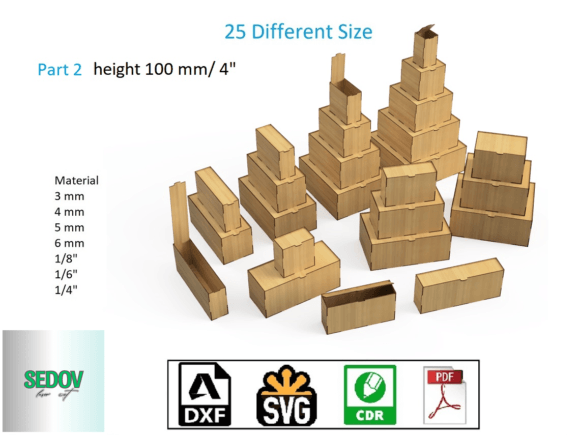
In the realm of custom fabrication and organization, finding a solution that balances precision, versatility, and aesthetic appeal can be challenging. Laser Cut Box Set Packaging and Storage has emerged as a sophisticated option for hobbyists, designers, and small business owners who require more than off-the-shelf containers. This system comprises storage boxes with flip lids, available in an extensive range of 25 different sizes, all sharing a standardized height of 100mm (4 inches). While this uniformity simplifies stacking and shelving, it also presents specific considerations for users who need varied vertical dimensions.
This article explores the practical applications, technical specifications, and decision-making factors associated with these laser-cut storage solutions. By examining the material compatibility, size variations, and finishing options, readers can determine whether this specific box set aligns with their organizational goals or if alternative approaches might serve them better.
Understanding the Laser Cut Box Set Design
The core appeal of Laser Cut Box Set Packaging and Storage lies in its modularity and precision. Unlike traditional cardboard or molded plastic containers, these boxes are crafted from flat sheets using laser cutting technology. This method allows for intricate joinery, such as finger joints or slot-and-tab assemblies, which provide structural integrity without the need for adhesives. The inclusion of flip lids adds a layer of functionality, offering easy access to contents while maintaining a clean, closed appearance when not in use.
A defining characteristic of this particular set is the uniform height across all 25 sizes. Every box stands at exactly 100mm (4 inches). This design choice is strategic for creating uniform stacks on shelves or in drawers. However, it introduces a tradeoff: users requiring deeper storage for taller items must rely on the larger footprints (length and width) rather than increased height. For those needing variation in height, the manufacturer suggests exploring other Stackable Box Sets or custom laser cut packaging options that offer different vertical profiles.
Material Compatibility and Thickness Options
One of the strongest advantages of laser-cut wood or acrylic boxes is the ability to select materials based on durability, weight, and finish preferences. These templates are optimized for a range of common sheet materials:
- Metric Thicknesses: 3 mm, 4 mm, 5 mm, and 6 mm.
- Imperial Thicknesses: 1/4 inch, 1/6 inch, and 1/8 inch.
The choice of thickness significantly impacts the final product. Thinner materials like 3 mm (approx. 1/8 inch) are ideal for lightweight storage, such as holding jewelry, sewing supplies, or small electronics components. They keep the overall weight of the stack low and allow for finer detail in the laser cutting process. Conversely, thicker materials like 5 mm or 6 mm (approx. 1/4 inch) provide robustness suitable for heavier tools, hardware, or industrial parts. The slot fit is calculated specifically for these thicknesses, ensuring a snug assembly that resists wobbling.
Size Variations and Internal Dimensions
The set offers 25 distinct internal volume configurations, allowing for granular organization. Below is a detailed breakdown of the internal dimensions for both metric and imperial measurements, assuming the standard 100mm height.
Metric Internal Dimensions (Length x Width x Height)
All heights are fixed at 100 mm. The following table outlines the length and width combinations available for 3 mm, 4 mm, 5 mm, and 6 mm materials:
- 50 mm x 50 mm
- 100 mm x 50 mm
- 150 mm x 50 mm
- 200 mm x 50 mm
- 250 mm x 50 mm
- 100 mm x 100 mm
- 150 mm x 100 mm
- 200 mm x 100 mm
- 250 mm x 100 mm
- 150 mm x 150 mm
- 200 mm x 150 mm
- 250 mm x 150 mm
- 200 mm x 200 mm
- 250 mm x 200 mm
- 250 mm x 250 mm
Note: The source data lists combinations systematically. For instance, starting with a 50mm width, lengths vary from 50mm to 250mm. This pattern repeats for widths of 100mm, 150mm, 200mm, and 250mm. This grid-like availability ensures that users can find a "cube" shape (e.g., 100x100) or elongated shapes (e.g., 250x50) to fit specific item geometries.
Imperial Internal Dimensions (Length x Width x Height)
For users working with imperial units, the corresponding internal dimensions (in inches) are provided below. Again, the height remains constant at approximately 4 inches (100 mm).
- 2" x 2"
- 4" x 2"
- 6.25" x 2"
- 8.3" x 2"
- 10.4" x 2"
- 4" x 4"
- 6.25" x 4"
- 8.3" x 4"
- 10.4" x 4"
- 6.25" x 6.25"
- 8.3" x 6.25"
- 10.4" x 6.25"
- 8.3" x 8.3"
- 10.4" x 8.3"
- 10.4" x 10.4"
These precise internal measurements are critical for planning. When designing your organization system, always account for the thickness of the walls. A box listed as 100x100 internally will have external dimensions larger by twice the material thickness (e.g., 108x108 mm for 4 mm material). This distinction affects how boxes fit within cabinets or alongside one another on shelves.
Comparing Laser Cut Boxes to Alternative Storage Solutions
To make an informed decision, it is helpful to compare Laser Cut Box Set Packaging and Storage against other common organizing methods.
Versus Plastic Modular Containers
Plastic bins are ubiquitous and often cheaper upfront. However, they lack the customization potential of laser-cut wood. Plastic bins often come in generic sizes that may not fit awkwardly shaped items perfectly. In contrast, laser-cut boxes can be tailored to exact dimensions. Furthermore, plastic can become brittle over time or develop static charge that attracts dust. Wood boxes, especially when sealed or painted, offer a more tactile, premium feel and can be integrated seamlessly into wooden furniture or workshop environments.
Versus Cardboard Organizers
Cardboard is lightweight and recyclable but lacks durability. It degrades with humidity and cannot support heavy loads. Laser-cut boxes, particularly those made from 5 mm or 6 mm plywood or MDF, are significantly stronger. They resist crushing and can be reused indefinitely. For archival purposes or long-term storage of valuable items, the rigidity of laser-cut materials provides superior protection.
Versus Standard Retail Packaging
Retail packaging is designed for marketing, not longevity. Laser-cut box sets are designed for utility and aesthetics. The flip lid mechanism in these sets is engineered for repeated opening and closing without failure, whereas retail clamshells or glued boxes are often single-use or difficult to reopen cleanly.
Customization and Finishing Options
A significant benefit of purchasing the template and fabricating the boxes yourself is the ability to customize the final appearance. You can paint the finished product in any color, stain it to match existing woodwork, or leave it natural for a minimalist look. This flexibility allows the storage boxes to blend into home decor, office spaces, or workshops.
Additionally, because you control the material selection, you can choose between hardwoods for durability, softwoods for ease of cutting, or acrylics for a modern, translucent aesthetic. The ability to paint or seal the interior also makes these boxes suitable for storing sensitive items, protecting them from moisture or chemical reactions.
When to Choose Laser Cut Box Sets vs. Other Options
Deciding to invest time and resources into laser-cut storage requires evaluating your specific needs. Consider the following scenarios:
- Choose Laser Cut Box Sets If: You value precision, want a unified aesthetic across multiple storage units, need durable containers for heavy or valuable items, and enjoy DIY projects. The uniform 100mm height is ideal for creating neat, stacked rows on open shelving where depth varies but height consistency is desired.
- Consider Alternatives If: You require significant variation in box heights to accommodate tall items (like books or bottles) within the same stack. In this case, explore other Stackable Box Sets that offer variable heights. Additionally, if you lack access to laser cutting services or equipment, the cost of outsourcing fabrication may outweigh the benefits compared to buying pre-made plastic or metal organizers.
Accessing Templates and Resources
For those ready to proceed, the foundation of this system is the digital template. Subscribing to the provider’s resources grants access to an extensive collection of box templates and laser cut files. These files are prepared for various material thicknesses, ensuring that the cuts are accurate right out of the file. This resource library extends beyond simple boxes, offering templates for caskets, cabinets, and complex geometric structures, making it a valuable tool for broader woodworking or design projects.
By leveraging these templates, users can create a highly customized storage ecosystem. Whether you are organizing a craft room, a workshop, or a home office, Laser Cut Box Set Packaging and Storage offers a blend of form and function that generic containers cannot match. The key is to carefully assess your space, item sizes, and material preferences before committing to a specific subset of the 25 available sizes.
Final Considerations for Implementation
Before ordering materials or sending files to a cutter, double-check your internal dimension requirements against the actual size of the items you plan to store. Remember to add a small clearance (1-2 mm) if items are tight-fitting, although the templates are generally designed with standard tolerances in mind. Also, consider the weight capacity of your shelving units; a stack of 6 mm plywood boxes filled with dense materials can become quite heavy.
Ultimately, the choice to use laser-cut storage is a balance between effort and reward. The initial setup requires planning and fabrication, but the result is a durable, customizable, and visually cohesive storage solution that can adapt to changing needs over time. For those who appreciate craftsmanship and precision, Laser Cut Box Set Packaging and Storage represents a superior long-term investment in organization.